



Welcome to Day 4! Now that we learned the importance of water and the role it plays in your body, the general recommendation for how much water to drink, along with other ways to properly keep your body hydrated, let’s now dive into the topic of dehydration further.
"What is dehydration?"
The Cleveland Clinic simply defines dehydration as “the absence of enough water in the body.”
Let’s paint a picture of what dehydration looks like. Picture yourself on a hot, summer day. You are feeling parched, so you reach for a nice, tall glass of cold water. Surprisingly, you have already begun to feel the signs of dehydration, mainly lightheaded and dizziness.
Dehydration occurs when your body loses so much body fluid that it cannot function properly or normally. Simply put - you lose more water than you are putting into your body.
Dehydration may occur in several ways - if you are sick with a fever, diarrhea, or vomiting, sweating a lot on a hot summer day, simply not drinking enough water, or are taking medication that increases your urine output (we also learned this in Day 2).
Our bodies are truly fascinating! Our body produces a natural response when it is not properly hydrated and that response is thirst. When our body sends this thirst response, it is our job to then respond quickly by drinking fluids - preferably water.
The Cleveland Clinic outlines some common signs and symptoms of dehydration in adults:
Fatigue
Headache
Dizziness
Weakness
Dry Mouth
Loss of Appetite
Flushed (red) Skin
Swollen Feet
Muscle Cramps
Chills
Dark-Colored Urine
Dehydration can be tricky at times to spot - such as with older adults who may forget to drink water or babies who cannot tell you that they are thirsty.
So, what do you think? “Can dehydration be prevented?”
..
.. drum roll
.. please
.. the answer is
.. YES!
One free and easy way to check to see if you are properly hydrated is to check the color of your urine. Simply put, (in most cases), if it’s clean or pale then you’re hydrated, if it's darker - keep on drinking!
Petar Bajic, MD who is a urologist at the Cleveland Clinic illustrates for us what is “normal” and what deserves some extra attention regarding our urine (pee) color by comparing it to the color of crayons.
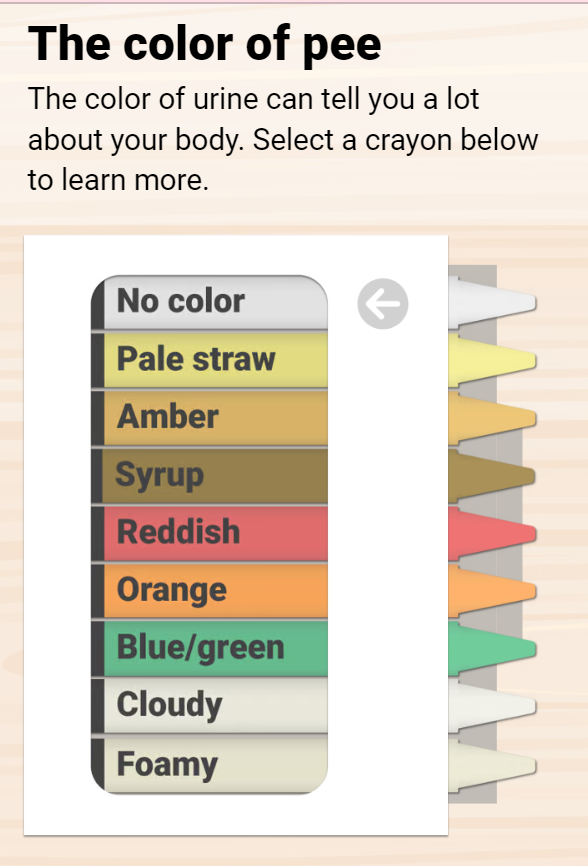
Interested in trying out this fun and interactive tool to better understand urine colors? Click here.
In addition to keeping an eye on your urine color, it is recommended to
Drink more water when you are being active or outside in warm climates.
Eat hydrating foods (such as the ones that we discussed in Day 2 of this course).
Limit alcohol, salt, and caffeine.
Be mindful of your medication (especially ones that are diuretics that can increase your urine production).
Note: Everyone’s hydration needs are different! Please consult your medical care provider for guidance on how to maintain the right level of hydration for you and to expand on the three categories of dehydration - mild, moderate, and severe. For more information on the dehydration categories and how it is diagnosed, click here.
The bottom line: Dehydration is not a joke and can cause serious and major problems for your health and body. The act of drinking water can be easily overlooked or forgotten as we are living very “busy” lives. Keep in mind that staying hydrated is critical and it is very important to know the signs and symptoms of dehydration for yourself and for those around you. If you or someone you know is experiencing moderate to severe signs of dehydration, it is very important to seek medical attention immediately by going to your nearest hospital.
Let’s take a moment to review what we have learned thus far in this course:
The importance of water and the role it plays in your body
General recommendations on how much water to drink
Other ways to keep your body hydrated
Dehydration signs and prevention
Come back and learn some tips on how to drink more water on Day 5.